
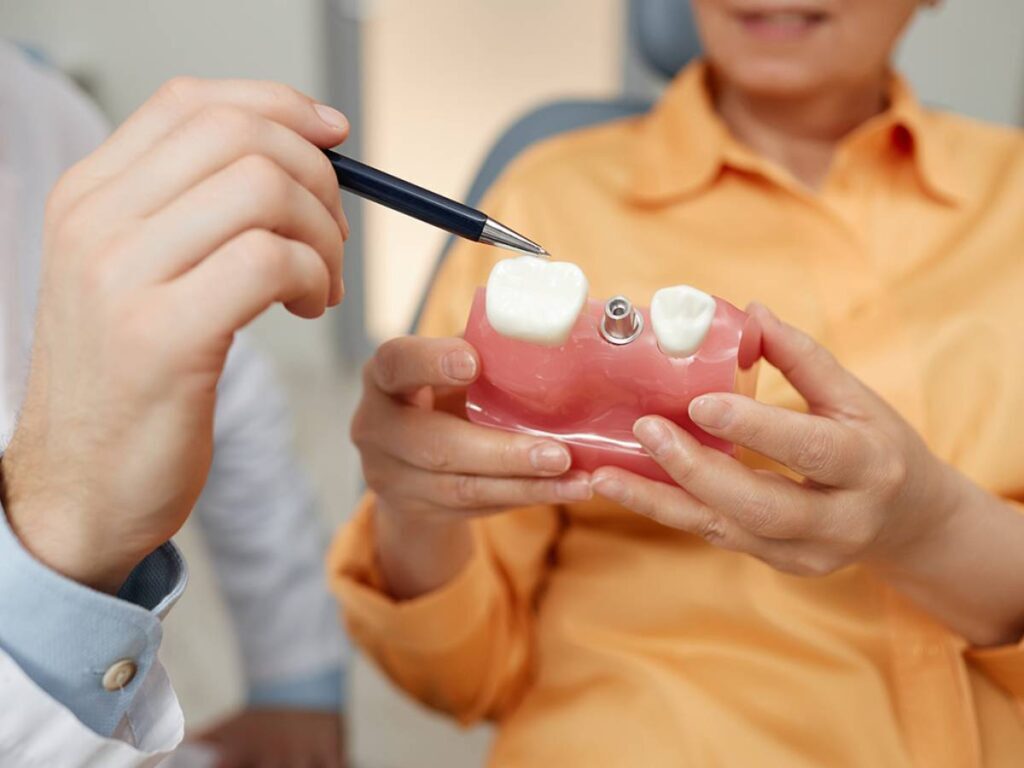
Losing a tooth can affect much more than the appearance of your smile. A missing tooth can make chewing more difficult, affect the way your teeth fit together, and leave you wondering what your options are for replacing it.
For many patients, dental implants offer a long-term way to replace missing teeth. But implants are not automatically the right choice for every person or every situation.
Depending on how many teeth you are missing, the health of your mouth and jaw, your lifestyle, and your goals, another option—such as a dental bridge, removable denture, or implant-supported denture—may make more sense.
At Gillespie Dentistry in Vancouver, WA, our team offers a wide range of tooth-replacement options, including single dental implants, All-on-4® dental implants, implant bridges, implant-supported dentures, removable dentures, and traditional dental bridges. This allows the practice to evaluate the bigger picture and help patients choose an approach that fits their needs.
So, when should you consider dental implants, and when might another solution be a better fit?
What Are Dental Implants?
For a single missing tooth, a dental implant can support an individual crown designed to look and function like a natural tooth. For patients missing several or all of their teeth, multiple implants can support a bridge or denture system.
Gillespie Dentistry in Vancouver, WA, offers several dental implant options, including single dental implants, All-on-4®, hybrid implant dentures, and implant-retained dentures.
Why Consider Dental Implants?
One of the biggest advantages of dental implants is that they replace the root of a missing tooth rather than simply replacing the visible portion.
Because the implant is anchored in the jawbone, it can provide a stable foundation for the replacement tooth or teeth. Implants may be worth considering if you want to:
- Replace a single missing tooth without a traditional bridge
- Replace several missing teeth
- Improve the stability of a denture
- Replace a full arch of teeth with a fixed restoration
- Restore chewing function after tooth loss
- Avoid a removable restoration when a fixed option is appropriate
- Have a long-term tooth-replacement solution
Your dentist will need to evaluate your individual oral health before determining whether implants are appropriate.
When Is a Single Dental Implant a Good Option?
If you are missing one tooth, a single dental implant and crown may be an excellent option to discuss.
Unlike a traditional bridge, a single implant does not need to rely on neighbouring teeth for support. The implant replaces the missing tooth's root, while the crown replaces the visible portion of the tooth.
This can make an implant particularly appealing when the teeth on either side of the missing tooth are healthy, and you would prefer not to use them as bridge supports. Gillespie Dentistry offers single dental implants and can complete the implant process in-house, from the initial consultation through implant placement and restoration.
What If You Are Missing Several Teeth?
Dental implants are not limited to replacing individual teeth. If you are missing several teeth, implants can be used to support an implant bridge or another implant-supported restoration.
This can be useful when replacing multiple teeth individually would not be practical or when a patient wants a more stable alternative to a removable partial denture.
The number and placement of implants depend on your anatomy, oral health, the location and number of missing teeth, and the restoration being planned.
What If You Are Missing All or Most of Your Teeth?
Patients who have lost most or all of their teeth have several potential treatment options. Traditional full or partial dentures can replace missing teeth and may be appropriate for patients who prefer a removable solution or whose circumstances make a non-implant option more suitable.
However, some patients want more stability than a traditional removable denture can provide. That's where implant-supported options may come into the conversation.
Gillespie Dentistry offers All-on-4®, hybrid implant dentures, and implant-retained dentures for patients who need more extensive tooth replacement.
All-on-4® vs. Implant-Retained Dentures
If you are missing an entire arch of teeth, you may hear about several implant-supported options. With All-on-4®, a full arch of replacement teeth is permanently attached to strategically placed dental implants. The restoration is not designed to be removed by the patient.
With implant-retained dentures, the denture attaches to dental implants but can be removed for cleaning and maintenance.
Both approaches can provide more stability than a traditional removable denture, but they are not identical. Your restorative team at Gillespie Dentistry will evaluate your oral health, lifestyle, goals, and preferences to determine which option may be appropriate.
When Might a Dental Bridge Be Better Than an Implant?
Dental implants are an excellent option for many patients, but they are not the only way to replace a missing tooth.
A traditional dental bridge may be worth considering if:
- You want to replace a missing tooth without implant surgery.
- The neighbouring teeth are healthy candidates to support a bridge.
- You prefer a fixed restoration.
- You are looking for a potentially faster tooth-replacement process.
- Your current oral health or medical circumstances make an implant less appropriate.
A bridge uses the teeth next to the gap for support, so the health and structure of those teeth are important considerations.
Gillespie Dentistry offers traditional dental bridges as part of its restorative dentistry services.
When Might a Removable Denture Be a Better Option?
A removable partial or full denture can be a practical solution for some patients.
Dentures may be particularly appropriate when several or all teeth need to be replaced, and a patient wants a removable option. They may also be considered when implant treatment is not appropriate or when factors such as treatment preferences, timing, or budget make a non-implant option more suitable.
Gillespie Dentistry offers full dentures, partial dentures, and temporary flippers, allowing our team to tailor treatment to each patient's situation. Choosing a removable denture does not mean you are choosing an inferior treatment. The goal is to select the restoration that best fits your oral health and circumstances.
Are Dental Implants Right for Everyone?
Although dental implants have a high success rate when appropriately planned and maintained, true candidacy depends on several factors. Your dentist may consider:
- The health and amount of available jawbone
- The condition of your gums
- Your overall oral health
- The number and location of missing teeth
- Your medical history
- Your ability to maintain good oral hygiene
- Smoking or tobacco use
- Your treatment goals and expectations
Some patients may need preliminary treatment before implant placement. Depending on your situation, this could include treatment for gum disease, tooth removal, or bone grafting.
Gillespie Dentistry offers bone grafting as part of our oral surgery services, allowing our team to address some of the factors that can affect implant treatment.
What If You Have Been Missing a Tooth for Years?
It is not necessarily too late to consider a dental implant simply because a tooth has been missing for a long time.
However, the jawbone naturally changes after tooth loss. In some cases, a patient who has been missing a tooth for an extended period may have less bone available to support an implant.
That does not automatically mean implants are impossible. Your dentist can evaluate the area and determine whether additional treatment, such as bone grafting, may be appropriate.
What Happens During an Implant Consultation?
The first step toward restoring your smile is an evaluation, not an automatic commitment to implant treatment.
At Gillespie Dentistry, Dr. Brad can evaluate your oral health, health history, lifestyle, and goals before recommending an implant approach. The practice also offers free virtual consultations, allowing prospective patients to begin exploring their options from home.
Your consultation may include an examination and imaging to evaluate the teeth, gums, jawbone, and surrounding structures. From there, your dentist can explain the available options and discuss factors such as treatment time, maintenance, expected function, and cost.
How Long Do Dental Implants Last?
Dental implants are designed as a long-term tooth-replacement solution. Gillespie Dentistry notes that successfully placed dental implants can last a lifetime, although the restoration attached to an implant may eventually require maintenance or replacement.
The longevity of your implant treatment depends on factors including oral hygiene, gum health, bite forces, overall health, and regular professional care.
Taking care of an implant does not mean you can stop seeing the dentist. Regular examinations and professional cleanings remain important for protecting the tissues around your implants and maintaining your overall oral health.
Is an Implant Always Better Than a Bridge or Denture?
The best tooth-replacement treatment is the one that makes sense for you.
An implant may be an excellent choice for one patient but unnecessary or inappropriate for another. A bridge may be ideal for someone who wants a fixed restoration without implant surgery. A removable denture may be the most practical solution for another patient. And someone who already wears dentures may benefit from implant support for improved stability.
The important thing is to compare your options rather than assuming there is one universal solution.
Which Tooth-Replacement Option Is Right for You?
If you are missing one or more teeth, you have options.
Dental implants can provide a stable, long-term foundation for crowns, bridges, and dentures. Traditional bridges can replace missing teeth without implant placement. Removable dentures can restore an entire arch or multiple missing teeth, while implant-supported dentures can provide additional stability.
At Gillespie Dentistry, our skilled restorative team offers these different approaches under one roof, including dental implants, implant bridges, implant-supported dentures, removable dentures, and traditional bridges.
That means your consultation can focus on finding the right solution for your particular smile—not simply fitting you into one treatment.
Considering Dental Implants in Vancouver, WA?
If you have a missing tooth or are struggling with an uncomfortable or unstable denture, it may be time to explore your tooth-replacement options.
Gillespie Dentistry in Vancouver, WA, provides comprehensive restorative care, including single dental implants, All-on-4®, hybrid implant dentures, implant-retained dentures, dental bridges, and removable dentures. Our practice's dentists provide a broad range of services in-house, allowing patients to explore different solutions without automatically needing to visit multiple offices.
Whether you are considering replacing one missing tooth or rebuilding an entire smile, the first step is a conversation. Schedule a consultation with Gillespie Dentistry to find out whether dental implants, or another tooth-replacement option, may be the right fit for your smile, health, and goals.

