
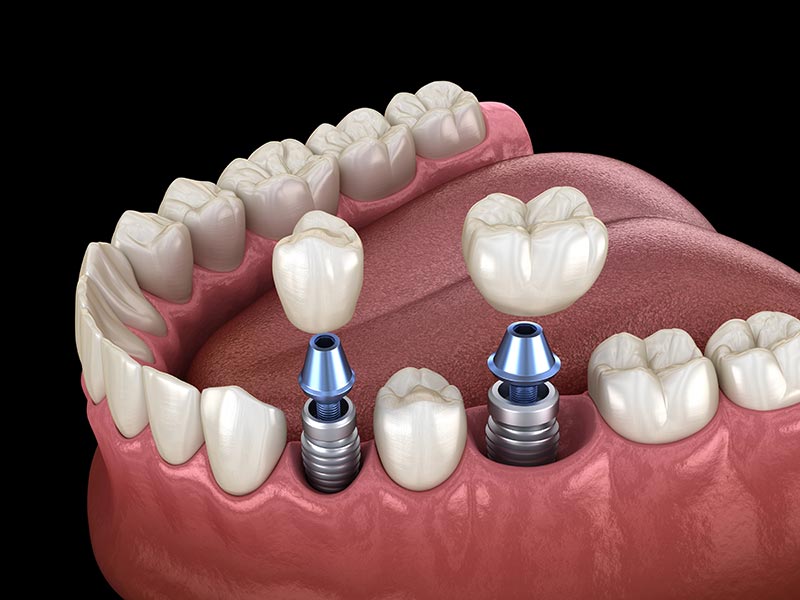
If you’re missing several or all of your teeth, dental implants can provide a stable foundation for replacing them. But when you start researching implant treatment, you may come across different approaches, including traditional dental implants and All-on-4® dental implants.
While both treatments use dental implants to support replacement teeth, they are designed for different situations. Traditional implants may be used to replace individual teeth or support bridges, while All-on-4 is a full-arch treatment designed to replace an entire row of teeth using a strategically placed set of implants.
So, which option is right for you? At Gillespie Dentistry, we can evaluate your oral health and discuss the approach that best fits your needs and goals.
What Are Traditional Dental Implants?
Traditional implant treatment can be used in a variety of situations. For example, a patient missing one tooth may receive a single implant and crown, while someone missing several teeth may receive multiple implants supporting a bridge or other restoration.
One of the major benefits of this approach is that implants can be placed where they are needed to replace individual missing teeth or support a larger restoration.
What Are All-on-4® Dental Implants?
All-on-4 is an implant-supported full-arch treatment. Rather than placing an individual implant for every missing tooth, the approach uses four strategically placed dental implants to support a full arch of replacement teeth.
The implants provide a stable foundation for a fixed full-arch restoration. Depending on your individual treatment plan, additional implants may sometimes be recommended instead.
One reason the All-on-4 approach can be useful for some patients is that implants can sometimes be positioned in areas of the jaw with greater bone volume, potentially reducing the need for extensive bone grafting in certain cases. However, this depends on your individual anatomy and treatment plan.
All-on-4 vs. Traditional Implants: What's the Difference?
The biggest difference is the number of teeth being replaced and how the implants are used to support the restoration.
Traditional implant treatment is highly versatile. One implant can support one crown, while multiple implants can support a bridge or other restoration.
All-on-4 is specifically designed to replace an entire upper or lower arch of teeth with a fixed implant-supported restoration using a strategically planned implant configuration.
Neither approach is inherently better than the other. They simply address different clinical situations.
Benefits and Considerations of Traditional Dental Implants
Traditional dental implants offer several potential advantages.
Benefits
- Can replace a single missing tooth without involving neighbouring teeth
- Can replace multiple missing teeth with an implant-supported bridge
- Can help preserve bone around the implant site
- Can provide a stable foundation for replacement teeth
- Offers flexibility in designing a restoration around the patient's specific tooth loss
Considerations
Traditional implant treatment may involve placing several implants when many teeth are missing. Treatment can also take time because the implants generally need to heal and integrate with the jawbone before the final restoration is placed.
Depending on the amount and location of available bone, some patients may also need bone grafting or other preparatory treatment.
Benefits and Considerations of All-on-4®
All-on-4 can be an option for patients who need to replace an entire arch of teeth.
Benefits
- Can replace a full arch using a limited number of implants
- Provides a fixed foundation for an implant-supported full-arch restoration
- Can offer greater stability than traditional removable dentures
- May be an option for some patients with significant tooth loss or bone loss
- Can sometimes reduce the need for extensive bone grafting, depending on the patient's anatomy
Considerations
All-on-4 is a full-arch treatment, so it isn't intended for someone who is simply missing one or two teeth. It also involves surgery and a healing period, and the treatment process can be more involved than replacing a single tooth.
The final restoration will also require ongoing care and professional maintenance, just like other dental implant restorations.
When Might Traditional Implants Be a Better Option?
Traditional implants may make more sense when you have one or several individual missing teeth but still have healthy, functional teeth that you want to retain.
For example, if you have lost one molar, replacing it with an implant-supported crown may allow you to restore that individual tooth without replacing the entire arch.
Multiple traditional implants may also be appropriate when several teeth are missing, but enough healthy teeth remain to make a partial restoration a better fit.
When Might All-on-4® Be a Better Option?
All-on-4 may be worth considering if you are missing most or all of the teeth in an upper or lower arch or have teeth that are severely compromised and require removal.
It may also be an option for patients who are looking for a fixed alternative to traditional removable dentures.
However, candidacy isn't determined simply by the number of teeth you're missing. Your dentist will need to evaluate your jawbone, gums, remaining teeth, bite, and overall health before determining which treatment approach is appropriate.
What About Bone Loss?
Bone loss is a common concern for people who have been missing teeth for an extended period of time. When tooth roots are no longer present to stimulate the surrounding bone, the jawbone can gradually change in shape and volume.
Dental implants can help provide stimulation to the jawbone around the implant site. For some patients with significant bone loss, the strategic placement of implants used in an All-on-4 treatment plan may make full-arch implant treatment possible when conventional implant placement would be more complicated.
That doesn't mean All-on-4 is automatically appropriate for everyone with bone loss. Advanced imaging and a thorough evaluation are important for determining which approach is suitable.
Which Implant Option Is Right for You?
Choosing between traditional implants and All-on-4® depends on your individual circumstances. Your dentist may consider:
- How many teeth are missing or need to be removed
- The condition of your remaining teeth
- Your gum health
- The amount and quality of available jawbone
- Your bite and overall oral function
- Whether you want a removable or fixed restoration
- Your overall health and medical history
- Your long-term goals for your smile
In some cases, traditional implants may be the most appropriate solution. In others, an All-on-4 full-arch restoration may provide a more suitable way to replace an entire row of teeth.
Explore Your Dental Implant Options with Gillespie Dentistry
Dental implants can offer several ways to replace missing teeth, but the right approach depends on your unique smile. All-on-4 and traditional implants aren't competing treatments so much as different approaches designed for different needs.
At Gillespie Dentistry, we can evaluate your oral health, discuss your goals, and help you understand your implant options. If you're considering dental implants or an All-on-4 restoration, a consultation is the best place to start.
Ready to learn more about replacing missing teeth? Contact Gillespie Dentistry to schedule a dental implant consultation.

